I Deleted Half My Agent's Instructions, and Here's What Happened
729 blind trials on CLAUDE.md and skill files. The same document scored 87% and 13% depending on nothing but the filesystem underneath it.

9 min read. 729 blind trials across 13 experiments, every one an isolated agent with no conversation history and no knowledge it was being tested.
In July, Boris Cherny sat down at Y Combinator’s Startup School. He built Claude Code. He said something that stuck with me:
“Every model is very different. So something that you did for one model maybe three months ago, it just might not translate at all to the next model.”
He was explaining why his team deleted over 80% of Claude Code’s system prompt when they moved to Opus 5. He also gave the rule for putting anything back: only when you see it repeatedly stumble on the same thing, and not too early.
I had a reason to take that personally. In April I read two Claude Code source trees side by side, v0.2.8 against v2.1.88. That is 211 files against 1,902, 13 months apart. I wrote up what the delta said about how the team thinks (Tracing the Minds Behind Claude Code). That piece was archaeology: infer what people believe from what they refuse to change. This one tests one of those beliefs against my own files.
I run a personal operations workspace. It holds a Columbia MBA’s worth of meeting notes, club logistics, coursework and immigration paperwork. A CLAUDE.md and 10 skills hold it together, 1,100 lines accreted over months. Boris’s claim implied most of it was dead weight.
So I measured. It took four passes to get an answer I trust. The last two were the ones worth having.
The setup
My workspace comes with free labels. 299 meeting notes, already filed by hand into 25 folders. The folder a note sits in is the answer a human gave.
The skill under test routes a meeting to its folder using a table of title keywords. I built three versions. v0 is the table as it shipped for months: 668 tokens, 7 course folders it never mentions, a wrong path, 3 rows made unreachable by row order. v1 is the same table repaired, 47% larger. v2 is a lean rewrite with no table at all, 52% smaller. Four lines: file it where it belongs, judge from content, use only paths that exist.
23 meetings per arm. Each one ran as an isolated agent seeing a single meeting and a single version, with no conversation history and no knowledge it was a test.
Pass one: nothing happened
| v0 | v1 | v2 lean | |
|---|---|---|---|
| accuracy | 91% | 91% | 87% |
Three versions, one of them missing 7 whole categories, all in the same place. My repair bought nothing. The obvious read is that the table is decoration. Delete it.
I nearly stopped there.
Pass two: everything happened
A loose thread. How did v0 route [NNDL] Lecture 14 into Coursework/NNDL/ when
its table has never contained the string “NNDL”?
Because I’d handed the agent a directory listing along with the task. That’s what the real skill does. It globs the folder before filing. The model wasn’t using the table. It was reading the filesystem.
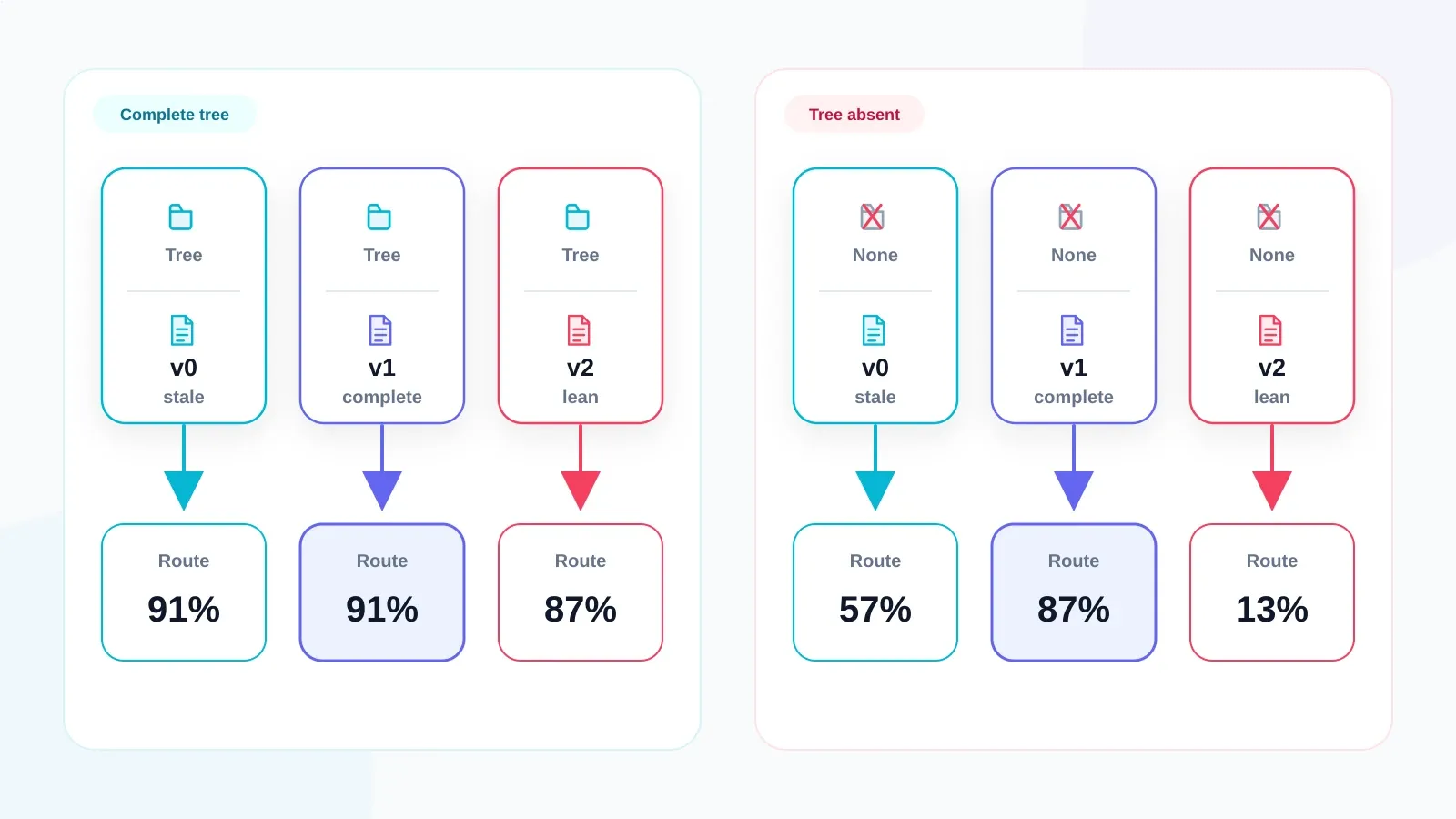
Figure 1. A healthy directory tree can make stale, repaired, and lean instructions look equally capable. Remove it and the underlying dependency appears.
Same experiment, listing removed: 57% / 87% / 13%. The lean version collapsed. It couldn’t even produce valid paths, because it had never been told what the paths were. Meanwhile the repair I’d written off was suddenly worth 30 points.
Pass three: environments don’t vanish, they go stale
Tree-or-no-tree isn’t how anything actually fails. Real environments fall behind. So I built a stale listing with 7 of 27 directories missing. They’re the same 7 the old table never named, so document and environment are out of date together.
| tree state | v0 stale doc | v1 complete doc | v2 lean doc |
|---|---|---|---|
| complete | 91% | 91% | 87% |
| stale | 61% | 87% | 57% |
| absent | 57% | 87% | 13% |
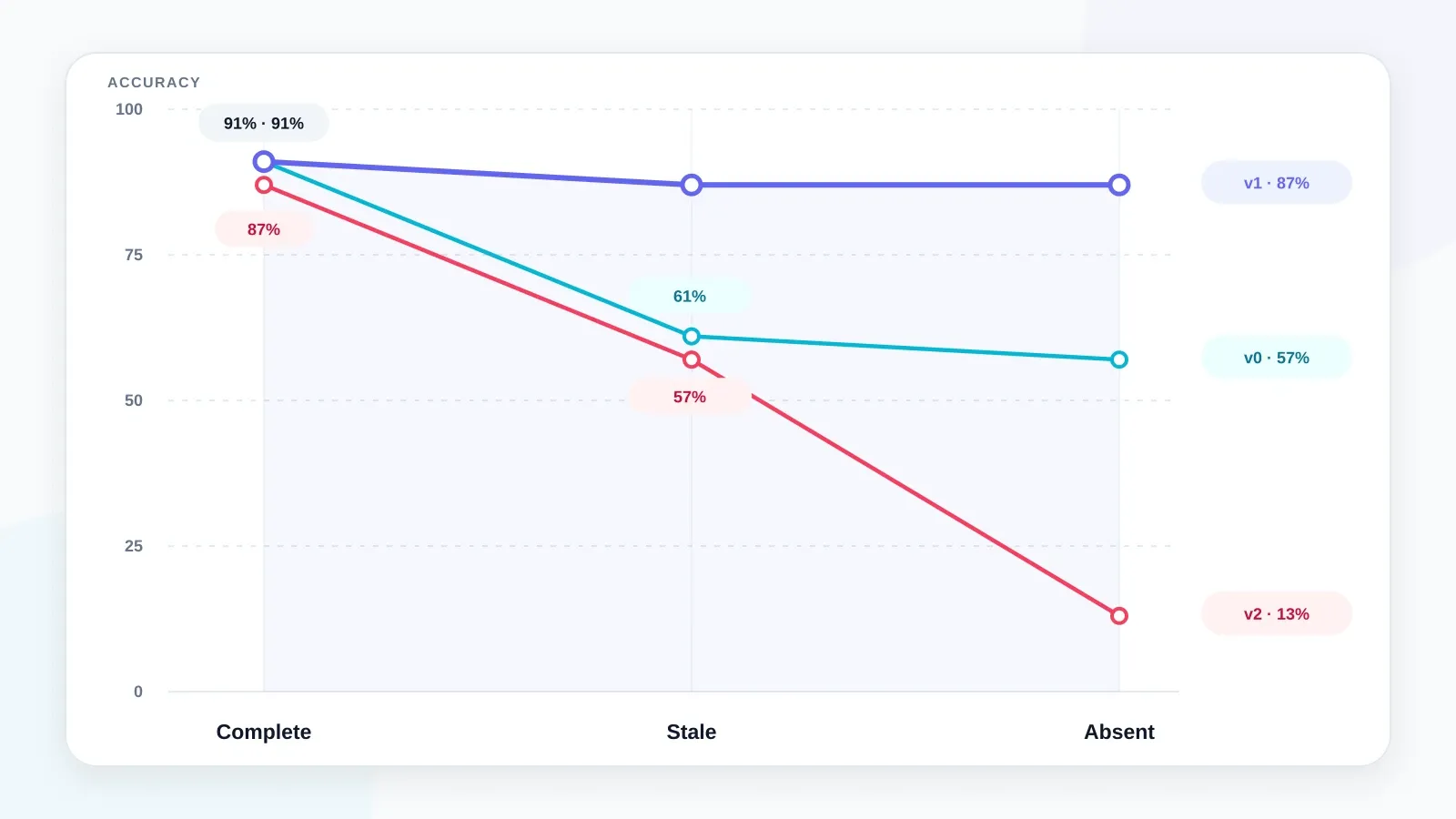
Figure 2. The complete document holds performance flat as the environment degrades. Stale and lean documents do not.
The complete version is flat in every environment. That reframes what the extra tokens are for. They don’t buy a better number on a good day. On a good day all three are identical. They buy the same number on a bad day.
Verbose documentation buys invariance, not accuracy.
I caught the mechanism in the act. Six trials wrote a directory path that wasn’t in the listing they’d been shown. All six were in the complete-document arm, and all six were correct. The document overrode a stale environment, which is precisely its job.
There’s a nastier detail in that middle row. When the document is also stale it scores 61%. That’s barely better than having no environment at all. Being partially up to date is close to worthless. The model trusts the list and stops looking. That’s the state every list decays into.
The prediction I made, then tested
If leanness works by delegating to the environment, it has to fail where the environment can’t answer. So I picked a task where it can’t: writing the note itself. The XML tag structure is pure convention. Nothing derives it.
Full template: 23/23. Lean template: 0/23. Not one.
Fair caveat. The lean template says “match the conventions used elsewhere in this workspace,” and my harness forbade reading the workspace. So this measures lean plus a withheld environment. That’s the point. A bet on the environment doesn’t degrade when it loses. It goes to zero.
Pass four: I’d been treating CLAUDE.md as one file
It isn’t. Claude Code loads several, on different schedules. An ancestor
CLAUDE.md loads at launch, and every session beneath it pays. A subdirectory
one loads on demand, only when Claude actually reads files there. @path imports
load eagerly, so an import costs exactly what inlining costs. .claude/rules/ with
a paths: glob loads on demand too.
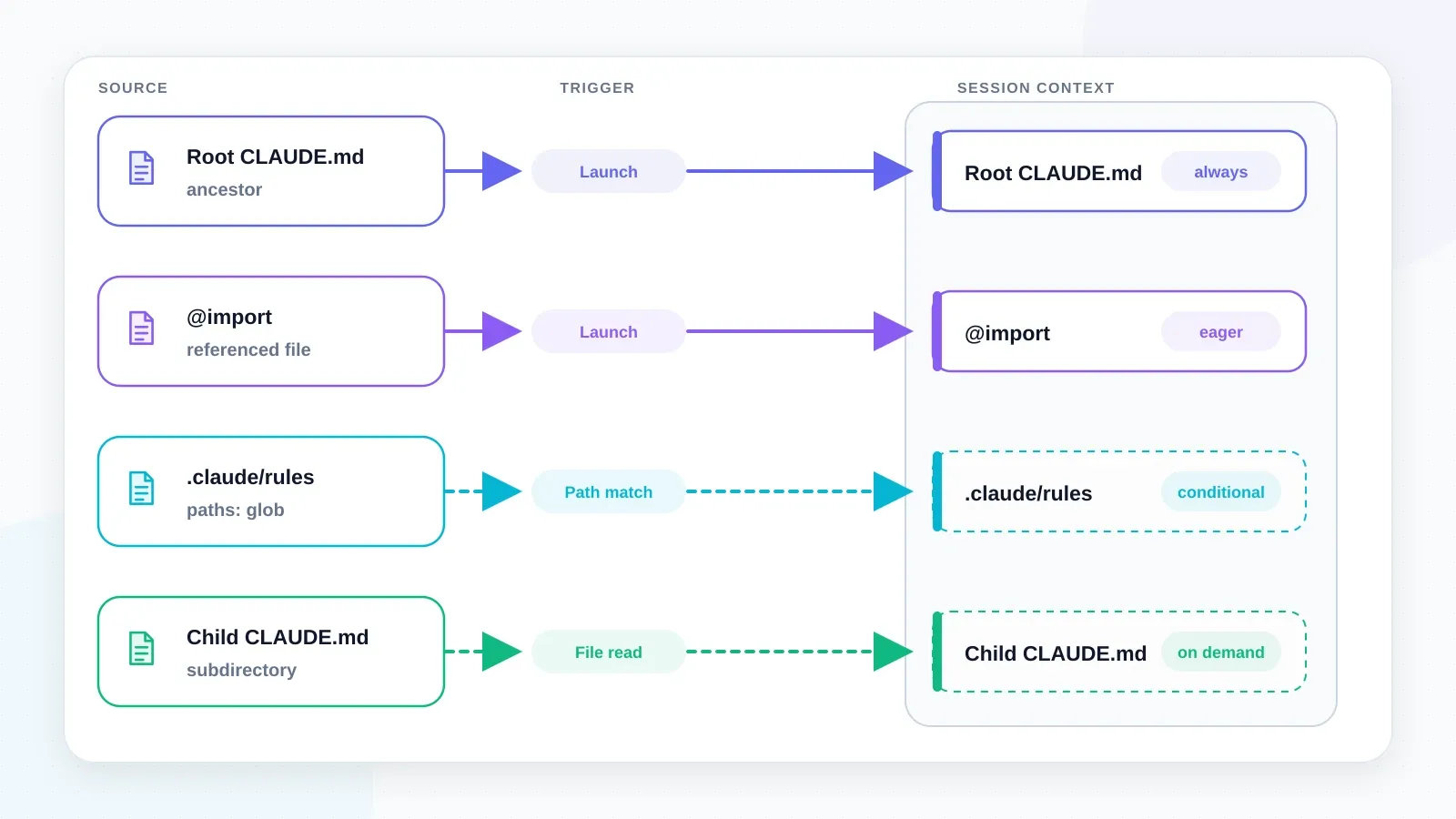
Figure 3. Instruction placement changes when context is paid. Root files and imports are eager. Rules and child files load only when their scope is touched.
This is the same shape I found in their source in April. Claude Code splits its
own system prompt at a marker called SYSTEM_PROMPT_DYNAMIC_BOUNDARY. Everything
before it is cached globally across every user. Everything after is
session-specific. It also stopped inlining 40+ tool schemas in favour of a search
tool that fetches them on demand. The team that deleted 80% of the prompt had
already spent years engineering where the rest of it loads. Context is not a
storage problem. It’s an economics problem. The question was never how much you
wrote. It’s who pays for it.
So where a fact lives is a separate decision from whether it should exist, with its own failure modes. Three arrangements of identical facts:
| capability | scope leak | ctx tokens | |
|---|---|---|---|
| everything at root | 21/21 | 6/6 leaked | 345 |
| stratified | 21/21 | 0/6 | 221 (−36%) |
| misplaced (inverted) | 18/21 | 6/6 | 256 |
Stratification is free on capability. But the column that stopped me was the middle one.
Everything-at-root leaked, 6 times out of 6. A session working on club logistics answered the immigration approval rate and named my tax preparer. That’s not a correctness failure. The flat arrangement scored 100%. It’s a scope failure. Every session gets facts it has no business holding. In a workspace carrying immigration status and tax detail, that’s a better argument for restructuring than tokens will ever be.
Then the obvious objection. What does pushing a fact down actually cost? Every task above was asked from inside the relevant sub-project, the case stratification is built for. So I asked from the root instead, with no sub-project file opened.
0 of 12 answered. The fact is simply gone.
But 12 of 12 said so. Several named the fix: “I would need to open the sub-project files to answer.” None fabricated.
Placement trades a certain, silent cost against an occasional, loud one. A narrow fact at root costs every session tokens and leaks scope every time, quietly. Pushed down, it costs root-level queries every time, loudly and recoverably.
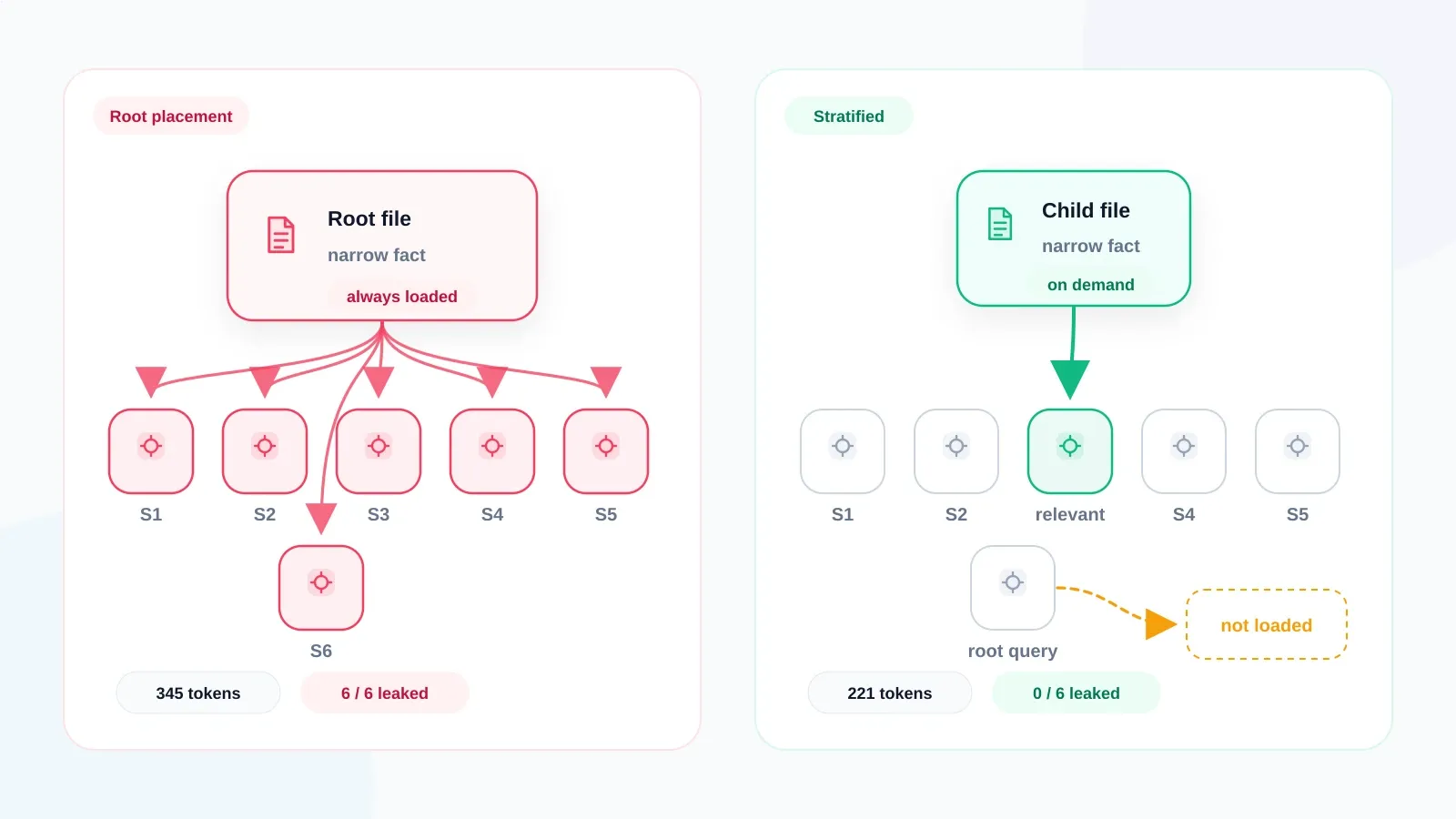
Figure 4. Root placement spends tokens and leaks scope in every session. Stratification confines the fact and turns a miss into a visible, recoverable event.
A loud failure gets fixed inside the same session. The agent reads a file in that directory, the child CLAUDE.md loads, the answer arrives. A silent wrong answer doesn’t.
Two smaller checks
Does this depend on the model? I ran the same trials on Sonnet 5 and Haiku 4.5. The complete document scored 21/23 on all three, identical. The lean one declined monotonically: 20, 19, 18. That’s directional, not proven at this sample size (p = 0.13). It’s the same structure as the environment finding, with model capability substituted in.
Does thinking harder rescue leanness? I predicted it would. Wrong. 91/91/91 for verbose and 87/87/87 for lean at low, medium and high effort. Identical, case for case. The same two cases fail every time, and they turn out to be genuine label ambiguity in my own filing.
Anthropic published the rules while I was measuring them
A week before that talk, Anthropic published the long version: six new rules of context engineering for Claude 5 models. I found it after the experiments were finished, which is what makes the overlap worth anything.
Their sharpest practical instruction:
“Avoid stating ‘the obvious’ things Claude should know by looking at your file system or your repo.”
Without having read that sentence, I had built an experiment on it. On a healthy repo it is exactly right. 91, 91, 87. Three documents, one of them missing 7 whole categories, indistinguishable. The condition is the other two rows of that table. The lean version loses 74 points when the file system stops answering, and stale is barely better than absent.
Three more places we line up, and one I’d push on.
“Let Claude use judgement.” This was the biggest single effect I measured, 26% to 91%. But it only works where the model has something to judge against. On a format convention: 0/3. On a policy: 0/3. There, given explicit permission to override, it invented a justification for a constraint I had made up for the trial.
“Consider having a tree of files that can be loaded at the right time.” That’s stratification, and it’s free on capability at 36% fewer tokens. They argue it on context cost. The stronger argument is the one they don’t make: 6/6 versus 0/6 on scope leak.
“No measurable loss on our coding evaluations.” I believe it. Coding evals run against real repositories, which is precisely the healthy environment where the advice holds. It’s also the claim I’d most want a sample size on. My own first pass showed no measurable loss either, right up until I noticed my harness was handing the agent a directory listing.
Three of their six rules I can’t speak to at all: examples versus interfaces, tool descriptions, auto-memory. No arms, no data. Worth saying out loud rather than implying coverage I don’t have.
They published the rules. What I have is the conditions under which they hold. The healthy-environment case, where the rules are most obviously right, is the one case where the difference is invisible.
What I’d actually tell you
Decide leanness against the worst environment you’ll run in, not the typical one. All three versions look equivalent on a healthy day. That’s the trap.
For every deletion, name what supplies the fact instead. A glob, a tool result, a file that’s always read. Then check it fires on every path in. If you can’t name it, you’re removing the only copy.
Classify before you cut. Procedure is often deletable. Convention, policy and plain facts aren’t. Stripping project context entirely dropped task success to 2/9.
Place a fact where it’s used, not where it’s convenient. Only needed while
working in one area? Put it in that subdirectory. Narrow but reachable from
anywhere? .claude/rules/ with a paths: glob, which is demand-loaded. Genuinely
cross-cutting? Root.
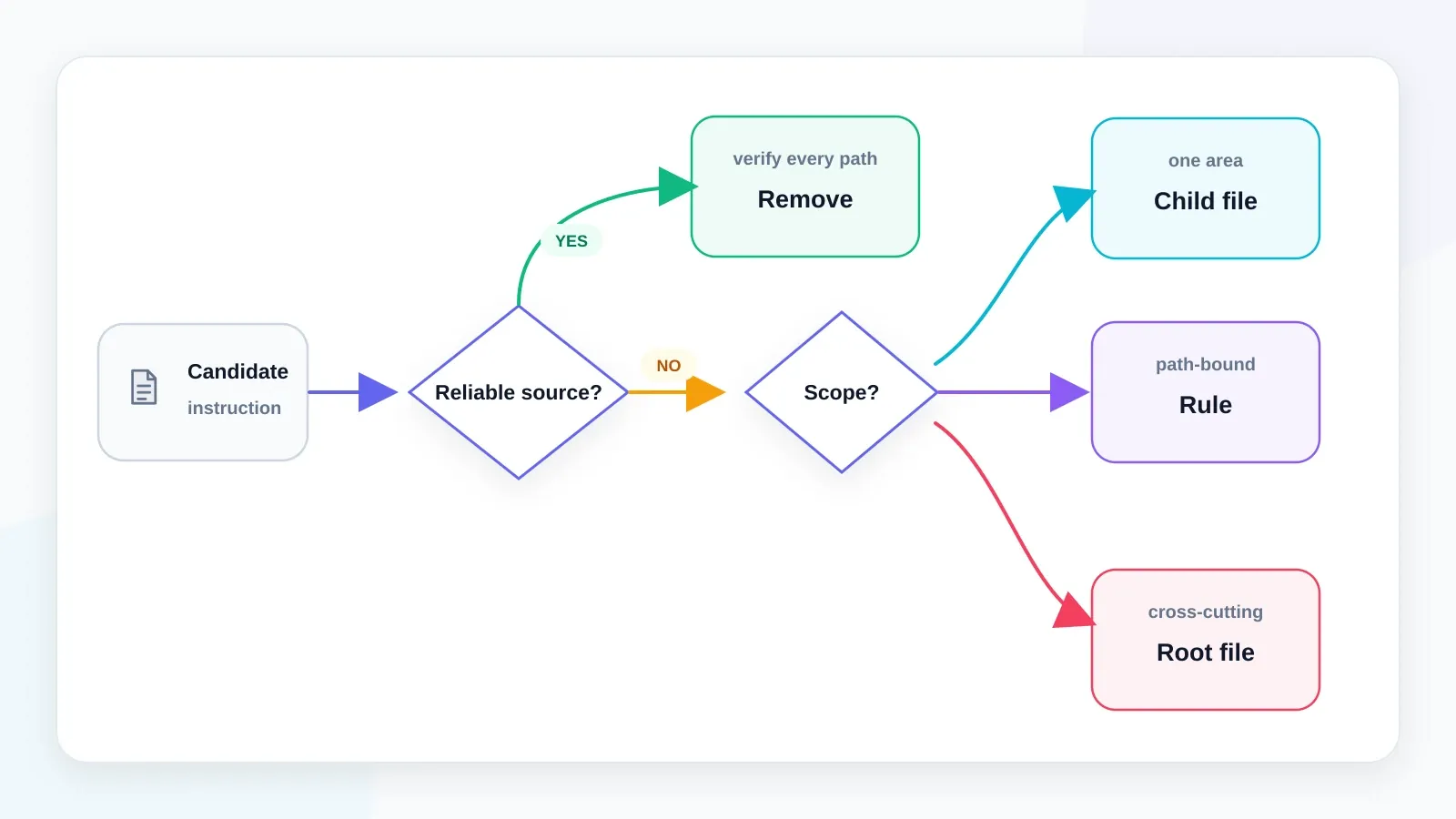
Figure 5. Delete only when a reliable source supplies the fact on every path. Otherwise keep it at the narrowest scope that still loads when needed.
Add a judgment clause to anything checkable. “Where the instruction and the actual content disagree, use your judgment.” Against a corrupted table it moved accuracy from 26% to 91% (p = 0.00001). Against a correct one it cost nothing. It does nothing for conventions or policies, where there’s no evidence to override from.
Run the boring checks first. Five real defects turned up across two skills and
the root CLAUDE.md: missing routes, a wrong path, unreachable rows, a partial
enumeration covering 4 of 25 directories, and a dangling pointer to a directory
that doesn’t exist. None came from the 624 trials I ran against those same files.
They came from reading them. /doctor will tell you what actually loaded. Nothing
tells you whether what loaded is true, so I wrote that reading down as a script
(audit_agent_docs.py). It found more than the entire experiment programme.
Limits
23 cases per arm on the content work, and 105 trials on placement using synthetic arrangements rather than my live files. The minimum difference this design can detect is 25 points. The portability gradient is directional, not established. The 36% token saving is specific to my ratio of global to narrow content and should be re-measured, not quoted.
An early version of this reported a much stronger result. Then I noticed my own evaluation prompt was instructing the model to follow instructions, and then scoring it for following instructions. Removing that wrapper moved one arm from 0/3 to 2/3. Half the original headline was my prompt.
What survives is two shapes. The lean document scored 87% and 13% depending on nothing but the environment handed to the agent, and the complete one never fell below 87% no matter what I did to it. And the same facts, moved between files, changed nothing about what the agent could do and everything about what it knew that it shouldn’t.
Boris was right that most of the prompt can go. What I’d add is that the 80% you delete doesn’t vanish. It moves, into the environment or into a file one level down. It’s only gone for as long as whatever now holds it keeps holding it up.
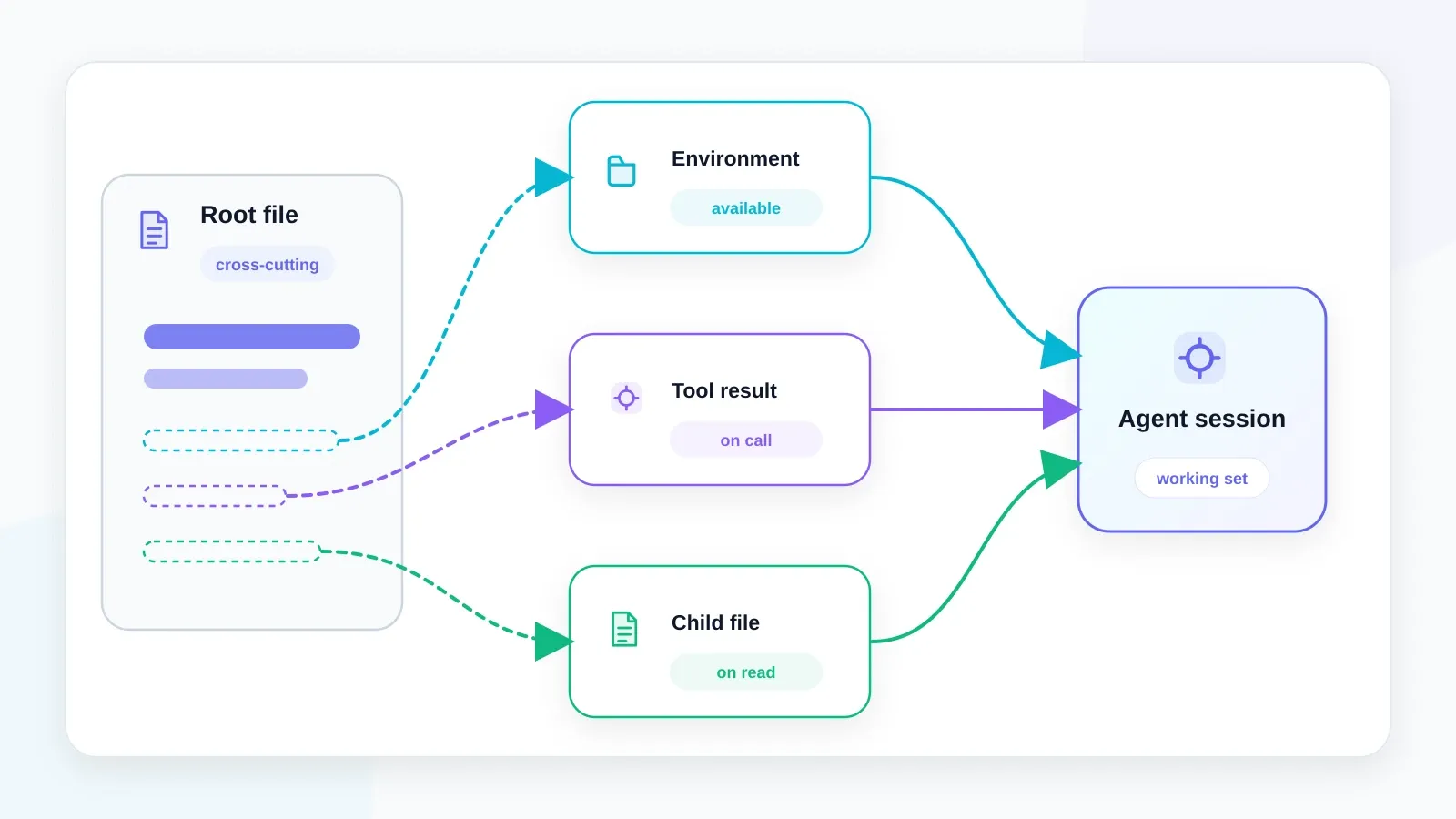
Figure 6. Deleting an instruction does not erase its responsibility. It transfers it to an environment, tool result, or lower-level file that must remain available.